Reviews on





A website redesign usually costs somewhere between $2,000 and $60,000 or more.
That range looks big, but that’s how these projects usually are. Some websites only need design updates, while others need a lot more work in the background.
The cost mainly depends on how much needs to change. Design, content, and overall complexity all play a part. Because of that, the exact cost is hard to pin down without looking at the website first.
A couple of years ago, we had a client who needed a redesign for their website (eCommerce business). They had hundreds of pages with thousands of products and other changes in UX and UI. The website redesign cost for their eCommerce project was almost $80,000.
Some redesign projects’ goal is to update the design and improve the user experience. While other website redesigns need to rework the structure, rebuild parts of the website, and add new features or website functionality.
So there’s no rule book that says this is what it’s going to cost you for the redesign.
As a WordPress website development company, we will break down what actually goes into website redesign costs and what you can expect based on your requirements.
- The cost is not the same for every website. It changes based on what needs to be done.
- Some redesigns are small. Others take a lot more work.
- Things like design, content, and features all add to the effort.
- It’s not only about looks. The way the site works also matters.
- Planning things early can save time later.
What is a Website Redesign?
Changing how the website looks is only a part of the website redesign. It’s not everything.
Most of the time, it also involves improving how the website works. For instance, fixing how pages are structured, making navigation easier, and cleaning up sections that don’t work well anymore.
Sometimes, the structure of the website is also adjusted so content is easier to manage. In some cases, even the content itself is reviewed and updated during the process.
Average Website Redesign Pricing
As we said earlier, website redesign costs can vary quite a lot depending on how much change you want in your website.
If you have a smaller website with design updates and fix a few things here and there, the cost usually lies between $3,000 and $6,000.
Larger websites are totally different. If there are too many pages with too much content, custom features, and advanced functionality, the cost can be more than $15,000, maybe up to $30,000 or even more.
The only thing that decides the cost is the amount of work that needs to be put in. A simple visual redesign will take a few days, but a full-fledged redesign with structural changes will definitely take more time and resources.
Work with cmsMinds to plan and redesign your website without unnecessary delays.
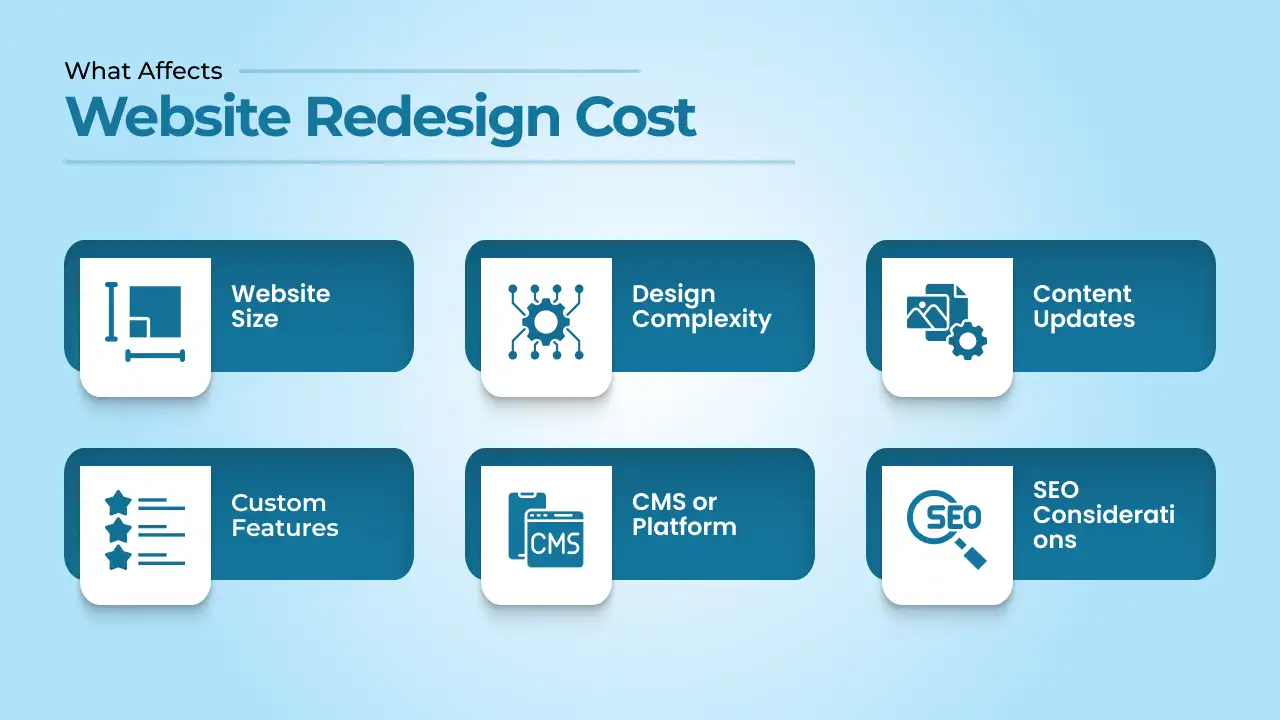
What Affects Website Redesign Cost
There’s no fixed price for a website redesign. What drives the cost up or down is the fact of how much needs to be changed in the website and how your existing website is set up.
1. Website Size
The number of pages a website has is one of the biggest factors. Let’s say, a website with 5-10 pages is easier to handle. But can the same be said for a website with 50 or 100+ pages? Of course, not.
Also, it’s not just about updating pages. On some websites, each page has a different layout, content type, or functionality. All of that needs to be properly reviewed and tested.
Large websites also take more time during testing or QA. Even a small issue on one page can affect other things on the website. So everything has to be checked properly before launch.
2. Design Complexity
A basic website redesign means enhancing layout and spacing. But if websites need more detailed designs, then it means more work behind the scenes.
Custom sections, unique layouts, and interactive elements all take time to build and test. Even things like responsiveness across browsers and devices will add more effort to the work.
Redesign is not just about how it looks. It also affects how users move through the website. So changes take place across multiple pages and need adjustments.
3. Content Updates
In very few cases, content is ready to move. We have seen this in many website redesign projects; the content is either outdated, inconsistent, or not structured correctly. This often means the content has to be reviewed, cleaned up, and maybe sometimes rewritten.
There’s also formatting. Like, sometimes content from the old website doesn’t always fit well into the new design. So you have to adjust it. For websites with too many pages and content, this alone will take a good amount of time.
4. Custom Features
Custom features or advanced functionality are altogether another job. Features like booking systems, member areas, dashboards, or advanced forms cannot be moved directly, nor always. You have to rebuild them or replace them with something similar.
Plus, a lot of testing is involved in site redesign. No matter what features or functionality you are adding, you have to test to ensure they work properly across devices and browsers. This will add to the development and QA time.
5. CMS or Platform
More than anything, the platform plays a much bigger role than most people think. If you are redesigning with the same content management system or platform, more or less, the process is easier. But if the current website is one platform, and the redesign is on another, it comes more like a rebuild than a simple redesign.
When we are talking about redesign on a new platform means moving to a different platform. So Content structures, features, and workflows may all need to be rethought. And this will add an enormous amount of time and complexity to the project.
6. SEO Considerations
Just like in website migration, search engine optimization is affected during redesign, too. This is especially true when the structure or URLs change. For instance, things like redirects, metadata, internal linking, and page hierarchy need to be handled carefully. Even if one of these is missed, your website traffic can drop drastically.
The review process should also be counted. You have to make sure the website isn’t missing any important information, and search engines can still understand the website properly after the redesign.
Website Redesign Cost Breakdown
As a WordPress web redesign agency that has done so many redesigns, the total project cost of a website redesign is never about one task. Usually, the cost is spread across different stages of the project.

Here’s where most of the time and effort usually go.
1. Planning and Research (10-15%)
To redesign a website, it usually starts with going through the existing site. This is where you look at what’s working and what isn’t. Some pages may need changes, some can be removed, and a few might stay as they are. In some cases, there’s also a quick look at how people are using the website and where things feel confusing.
2. Design (20-30%)
This is the stage where the visual part of the redesign process takes place. Developers create layouts, plan sections, and update the overall look of the website. Plus, in this stage, user experience also matters, not just the appearance of the website. If your website has more detailed designs with custom sections or interactions, it will take more time and increase the cost of the website.
3. Development (30-40%)
Web development takes the largest share of the budget. Because in this stage, design is turned into a working website. It includes building pages, setting up functionality, and making sure everything works properly. Custom functionality, integrations, and complex layouts of the website can drastically increase effort in this stage.
4. Content Work (10%-20%)
Content is where things slow down a bit. It’s rarely a clean copy-paste job. Some pages don’t fit the new layout. Some feel too long. Others just need fixing. So time goes into adjusting things as you move them. On bigger websites, this part alone can take a while.
5. Testing and Quality Assurance (10%-15%)
Before going live, we usually spend some time just going through the site. Open a few pages, check forms, see how it looks on mobile devices, that kind of thing. Small issues tend to show up here. It’s better to sort them out now rather than notice them later.
6. Launch and Final Setup (5%-10%)
After everything looks fine, the site is pushed live. Domain gets connected, web hosting is set, and things are checked once more. Nothing major usually, just making sure everything is running the way it should.
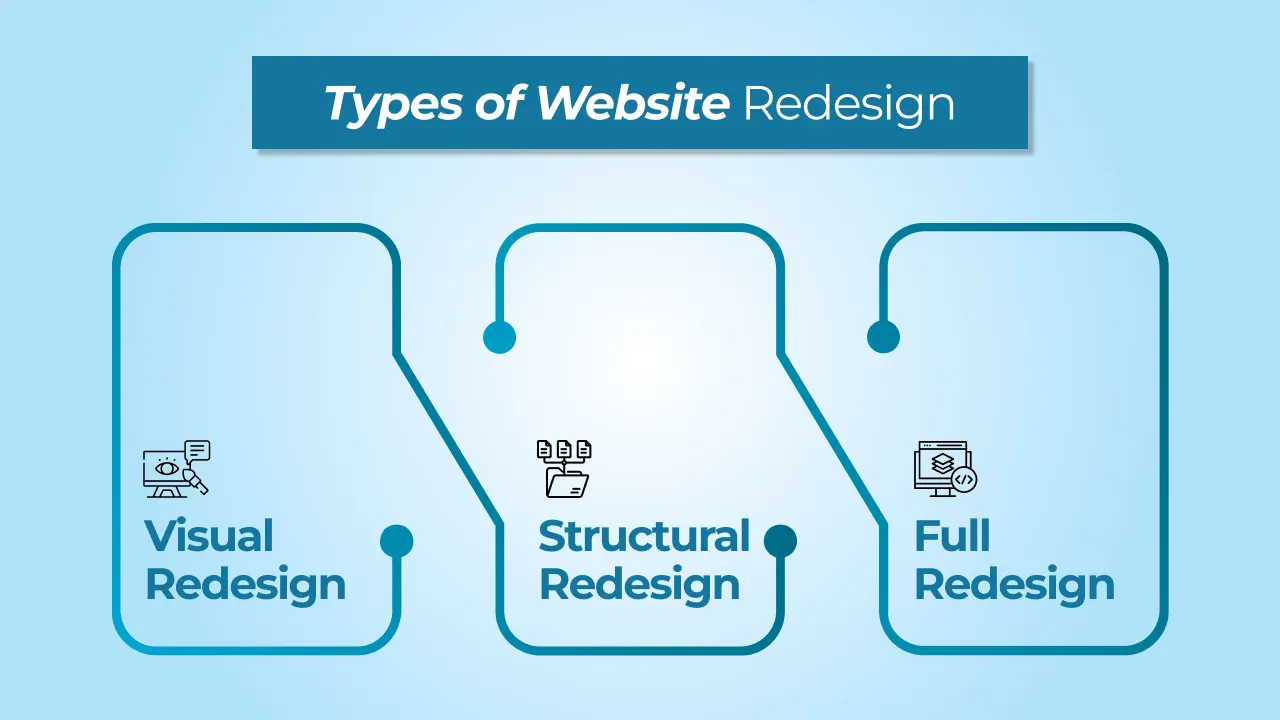
Types of Website Redesign
Not all redesigns mean the same thing. The cost mostly depends on what kind of redesign your website needs.
1. Visual Redesign
This is the simplest redesign. This particular redesign mainly focuses on how the website looks. Things like layout, color palette, fonts, and spacing are usually enhanced to match the business’s brand and values. But the overall structure is going to stay the same. Since the backend and content structure have not changed too much, visual redesign takes less time and even costs less too.
2. Structural Redesign
Structural redesign is one step further than visual design. What happens in this type of redesign is that, along with design changes, the structure of the website is also updated. Navigation can be reorganized, pages can be added or removed, and content, too, can be rearranged. Now, this kind of redesign usually takes more time as it involves both design and planning.
3. Full Redesign
This is almost rebuilding the entire website. Right from design, structure, and content to functionality, everything will be redone at this point. Some businesses move their website to a new platform, too. This will take a lot of time, effort, and resources, and hence it costs more.
Hidden Costs to Be Aware Of
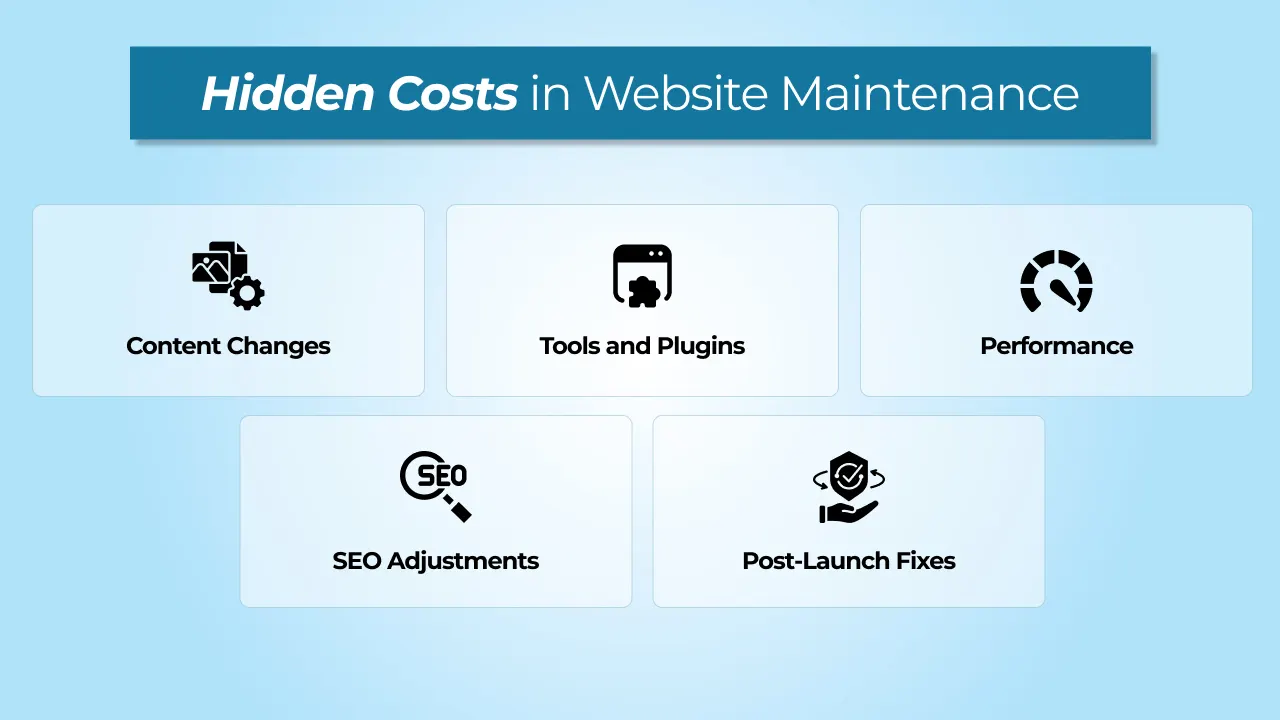
Website redesign usually means design and development, but not always. There are a few things that can come up during the project for which you will be charged.
1. Content Changes
If content needs to be rewritten because it’s not fitting the new design properly, some pages require updates, or any other reason, it doesn’t matter. If the content has to be rewritten or reorganized, it can take time and cost.
2. Tools and Plugins
Some features to properly function, they either need paid plugins or third-party tools. For instance, forms, security tools, performance tools, or even integrations. Some of these are one-time incurred costs, but some of them may have ongoing subscriptions.
3. Performance Improvements
In some websites, redesign means fixing performance issues. Like fixing slow loading times or improving how the website runs, it may need some extra work. Although this is not decided early in the project development stage, it later becomes necessary.
4. SEO Adjustments
If the website redesign has a structure or URLs change, then SEO work is inevitable. Developers have to check on things like redirects, metadata updates, and basic SEO to maintain search visibility. This step can be done either during or after the redesign.
5. Post-Launch Fixes
Even though launch is the last step, some small issues might still come up. These things are not that big generally, but they still have to be addressed and fixed. It takes some time.
Redesign vs. Rebuild: What’s the Difference?
Not every redesign is a full rebuild. In some cases, a redesign is just a change of visual appearance, and in others, a redesign means a fresh website.

When a Redesign is Enough
A redesign is enough when the issues are mostly on the surface. Maybe the website looks old, or some sections don’t feel right anymore. In these situations, you can keep the current setup and just update the parts that need improvement.
When a Rebuild Makes More Sense
On some websites, the problem is more than just the design. The website may be too slow, difficult to manage or update, or was built on an outdated structure. In cases like these, making changes just on the surface level won’t do the job. It’s not enough. In fact, it can be more complicated than rebuilding the entire website.
How to Decide
If your website still works well in the background and only needs improvement in a visual or structural sense, a redesign is enough.
But if your website has more complex issues than just design or looks, and you find yourself repeatedly dealing with performance problems and other issues, a full rebuild is a better option in the long-term.
Freelancer vs. Agency: What Should You Choose?
If you are planning to redesign your website, you have two options. Either go with a freelancer or an agency. Both options are great, but which is the right option for you?
Working with a Freelancer
You can go with freelancers if your website is more of a small project. Let’s say your website is simple and the changes you need are limited; a freelancer can easily handle this kind of redesign work. Hopefully, your costs will be lower, too. Communication is mostly direct, and the process can also be a little flexible.
Now, let’s see the downside of working with freelancers. They usually work alone. This means design, development, testing, and fixes are all taken care of by one person. This can slow things down because they have to manage everything themselves.
Working with an Agency
An agency comes with a development team of people who will work dedicatedly on your project alone. A team that has designers, developers, and project managers. Thanks to this, work can be managed by each person simultaneously. Plus, the process will be more structured, too. Agencies are a better option for larger websites, redesigns with multiple requirements, or even projects that need ongoing maintenance and long-term support.
Which One Makes More Sense?
If your website redesign is small and pretty straightforward, a freelancer is a good choice.
But if your website is a little complex with multiple requirements or needs more attention, working with a website design agency is the safer option.
Get a clear idea of what needs to change and how much it could cost.